Roll-Off Dispatch Terms Explained: Swaps, Finals, Live Loads, and Dry Runs
Every roll-off order is one of six types, and the type you pick decides how many truck trips it costs, what happens to your yard count, and which invoice line the customer sees.
Here is what each of the six means and where they go wrong.
Short Answer
There are six roll-off order types. A delivery places an empty container on site and starts the rental clock. A swap drops an empty and removes a full one in the same visit, keeping the customer in service continuously. A dump and return takes the full container to the disposal facility and brings that same container back to the site. A final removes the container for good and stops the rental clock. A live load holds the truck on site while the customer loads, then hauls immediately. A relocation moves a container to a different spot on the same property or a different address.
A dry run, sometimes called a dead run, is not an order type at all. It is a failed one. The truck arrives and cannot complete the work because access is blocked, the container is overloaded, or the customer canceled without telling anyone. Dry runs cost you twice, once for the fuel and driver hour you spent and once for the revenue trip you gave up to make room for it.
The distinction that costs operators the most money is swap versus dump and return. A swap consumes a second container out of your yard for the duration of the round trip. A dump and return does not, but it ties the truck to that one address for two visits and leaves the customer without a container while the truck is at the scale. Pick the wrong one and you either run short of cans on a busy Friday or you burn an hour of truck time you did not need to spend.
Why Order Type Is the Most Important Field in Your System
Roll-off dispatch looks simple from the outside. Containers go out, containers come back. In practice the order type is the single field that drives three separate downstream systems at once, and when it is wrong or missing, all three go wrong together.
It drives the route, because each type consumes a different amount of truck time and requires the truck to arrive in a different state, either carrying an empty container or with an open bed. It drives inventory, because some types remove a container from your available pool and some do not. And it drives billing, because the type determines whether a haul charge, a disposal charge, a rental period, or nothing at all lands on the invoice.
A dispatcher working from a whiteboard holds all three of those relationships in their head. That works at twelve orders a day. At forty it does not, and the failures show up as a truck sent out with an empty on the bed for a job that only needed a pickup, a container that the system says is in the yard but has been sitting on a finished job for five weeks, and a weight ticket attached to the wrong order so the overage never gets billed.
The rest of this guide defines each type precisely, then works through what each one does to your fleet count and your invoice.
The Six Roll-Off Order Types
1. Delivery
A delivery, also called a drop or a set, places an empty container at a customer address. The truck leaves the yard with an empty container on the bed, arrives, positions and rolls the container off, and departs with an open bed.
The delivery starts the rental clock. Whatever billing structure you use, whether that is a flat rate covering a stated rental period or a daily rate, the meter begins here rather than at the date the order was booked. It also moves the container from available inventory to deployed inventory, tied to a specific customer and address.
Delivery is the only order type where the driver arrives carrying a container and leaves without one, which makes it the natural chaining partner for a final or a swap earlier in the same route.
2. Swap
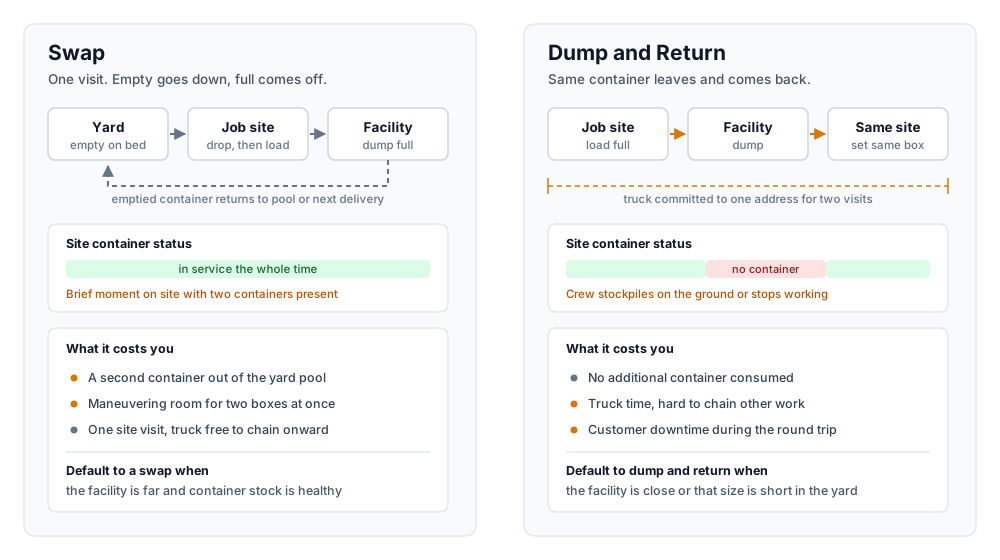
A swap, also called an exchange, replaces a full container with an empty one in a single visit. The truck arrives carrying an empty, sets the empty down, loads the full container, and hauls the full one to the disposal facility.
Swaps exist because the customer cannot afford to stop working. On an active demolition or a roofing tear-off, a crew that runs out of container capacity stops producing. The swap keeps a usable container on site continuously, which is why it commands a premium over a delivery and a final booked separately.
Two things about swaps catch operators out. The first is a site constraint. For a brief period during the visit the site holds two containers, because the driver has to set the empty down before there is room on the bed for the full one. A driveway that fits one container comfortably may not have the maneuvering room for that moment, and the driver discovers this on arrival rather than at booking.
The second is inventory. A swap pulls an additional container out of your available pool and does not return it until the full one has been dumped and the emptied container is either back in the yard or placed on the next delivery. On a heavy swap day, a fleet that looks adequate on paper runs short in the afternoon.
3. Dump and Return
A dump and return takes the full container from the site to the disposal facility, empties it, and brings that same container back to the same location. The truck arrives with an open bed, loads the full container, drives to the scale, dumps, and drives back.
The advantage is that it does not consume a second container. If your fleet is tight, or the container is a specialty size you only own two of, dump and return preserves your count.
The cost is truck time and customer downtime. The truck is committed to that one address for what amounts to two visits inside one trip, and it cannot chain other work in between unless the facility happens to sit conveniently between other stops. Meanwhile the site has no container at all, so the crew either stockpiles debris on the ground or stops. On a long haul to the landfill that gap can run most of an afternoon.
The decision between a swap and a dump and return is a real operational tradeoff and it deserves a rule rather than a coin flip. Most operators default to swaps when the facility is far from the site and container inventory is healthy, and to dump and return when the facility is close, the container is a size they are short on, or the customer is not actively loading that day.
4. Final
A final, also called a final pickup, a removal, or a pull, ends the rental. The truck arrives with an open bed, loads the container, and hauls it to the disposal facility. The container then returns to the yard or goes straight to the next delivery.
The final stops the rental clock, which makes it the single most billing-sensitive order in roll-off. Every day between when the customer stopped using the container and when the final actually happened is either a day you can bill or a day you will argue about, depending entirely on what your rental agreement says and whether you can prove when the pickup request came in. This is the same off-rent problem that shows up on the fence side of the business, and the fix is identical, which is a timestamped request rather than a remembered phone call.
A final is also the moment your inventory count is supposed to correct itself. If the container that comes back does not match the container the system says was out there, you have a reconciliation problem that started weeks earlier.
5. Live Load
A live load keeps the driver and truck on site while the customer loads the container, then hauls it away on the same trip. Nothing is left behind.
Live loads solve two specific problems. The first is placement restriction. A downtown job with no legal spot to leave a container overnight, a permit that does not allow street occupancy, or an HOA that prohibits containers on the street all rule out leaving a box in place. The second is speed. A cleanout crew that can fill a container in ninety minutes has no reason to pay for a multi-day rental.
The economics are different from every other order type. You are selling truck and driver time rather than container time, so the pricing has to be built around a load window with an explicit overage rate for waiting beyond it. Without that, a live load quoted at a flat rate turns into unpaid detention the moment the customer's crew is slower than promised, and detention on a roll-off truck is expensive because it blocks every other job that truck could have run.
6. Relocation
A relocation moves a container from one position to another, either a different spot on the same property or a different address entirely. The truck arrives with an open bed, loads the container, and sets it down again.
Relocations are usually small revenue and outsized risk. A move within a site is billable trip time. A move to a different address is more complicated, because it may change which customer or which job the container is billed against, and if the system does not follow the container to the new address, you have just created a container that is physically in one place and logically in another.
Relocations are also where property damage claims come from, since the container is being set on ground that nobody assessed at the original delivery.
Comparison Table
| Order type | Truck arrives | Yard inventory effect | Rental clock | Typical invoice lines |
|---|---|---|---|---|
| Delivery | Carrying an empty | One container leaves the pool | Starts | Delivery or haul charge, rental period begins |
| Swap | Carrying an empty | A second container leaves the pool until the full one is dumped | Continues | Haul charge plus disposal, rental continues |
| Dump and return | Open bed | No change | Continues | Haul charge plus disposal, rental continues |
| Final | Open bed | Container returns to the pool after dumping | Stops | Final haul charge plus disposal, rental closes |
| Live load | Carrying an empty | Container leaves and returns the same day | Starts and stops same day | Haul charge, disposal, load window plus any waiting time |
| Relocation | Open bed | No change | Continues | Trip or relocation charge |
| Dry run | Either | No change | Continues | Dry run or trip charge if your agreement supports it |
What Each Order Type Does to Your Container Count
The most common inventory failure in roll-off is a container that the system believes is available and that is physically sitting on a job. Operators call it a phantom can. It has three main sources, and all three are order-type failures.
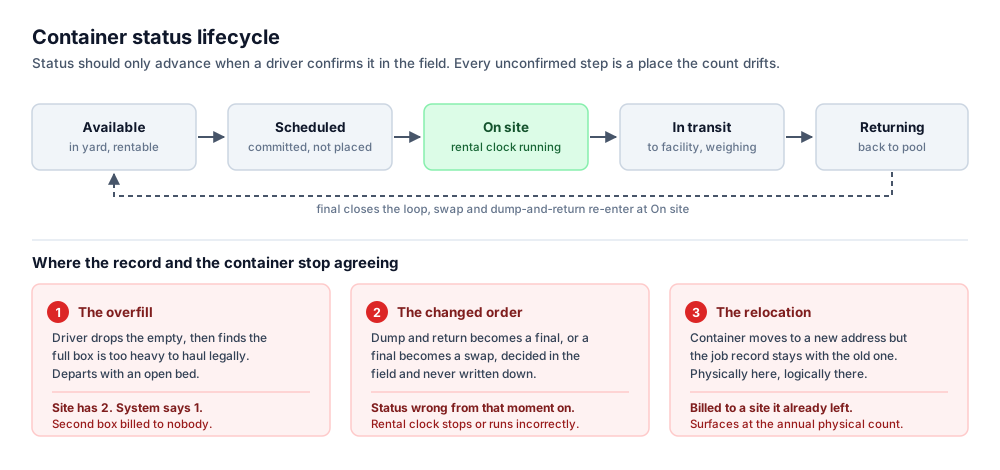
The first is the overfill. A driver arrives for a swap, sets the empty down, and then discovers the full container is loaded past what can be legally or safely hauled. The driver leaves the empty and departs without the full one. The site now has two containers. The system, which recorded a completed swap, thinks it has one. Nobody bills for the second, and it disappears from view until a physical count months later.
The second is the changed order. A dump and return gets converted to a final at the last minute because the customer decided they were done, or a final gets converted to a swap because they were not. If the order type changes in the field and the record does not follow, the container's status is wrong from that moment forward.
The third is the relocation to a new address. The container moves, the job record does not, and now the container is being billed to a site it left.
None of these are exotic. They are the ordinary friction of a business where the schedule gets rewritten several times a day, which is exactly why the reconciliation has to be systematic rather than remembered. The practical control is a container status that only advances when a driver confirms it in the field, plus a monthly physical count against the system of record. More on the mechanics of that in our guide to what running on spreadsheets actually costs.
What Each Order Type Does to the Invoice
Disposal is billed by weight, and the weight comes from the scale rather than from an estimate. The facility weighs the truck loaded and empty, and the difference is the net tonnage that gets compared against whatever allowance the customer's rate includes. Anything over the allowance is an overage, passed through at a per-ton rate.
That is straightforward on a delivery and final. It gets subtle on a swap, and this is where money quietly disappears.
On a swap, the weight ticket belongs to the container that came off the site, not the empty that went on. Both containers touch the same order in the same visit. If your system attaches the ticket to the wrong one, or attaches it to the order without recording which container it came from, then a customer running three simultaneous containers on a large job cannot be billed accurately and cannot be shown a defensible breakdown when they dispute it.
The same applies to a dump and return, where a single container generates a weight ticket in the middle of a rental that has not ended. The ticket has to land on the current billing period without closing the rental.
The rule that survives all six order types is simple to state and harder to implement. Every weight ticket attaches to a specific container serial number and a specific order, captured at the scale rather than reconstructed at month end. If the ticket is a photo in a driver's phone that gets emailed in on Friday, some fraction of your overage revenue is never going to be billed. That is one of the larger line items in a full revenue leakage audit.
Dry Runs: The Trip You Pay For Twice
A dry run happens when a truck is dispatched to a job and cannot complete it. The container is blocked by a parked vehicle or a delivery truck, the gate is locked, the load is overweight, the site is inaccessible after rain, or the customer canceled and told nobody.
The cost is not just the wasted trip. It is the wasted trip plus the job you did not run in that slot. A roll-off truck completes a finite number of hauls in a shift, and every dry run permanently removes one of them from the day. That is why the honest accounting treats a dry run as costing roughly double the direct trip expense, because the displaced revenue haul is real money even though it never appears on any report.
Three controls reduce dry runs materially. The first is a confirmation step the day before on any order with a known access constraint, which catches the locked gate and the parked car. The second is a weight declaration at quote time, because the customer who says the container is full of drywall and the customer who says it is full of concrete are describing two completely different pickups, and one of them cannot be hauled. The third is a dry run charge that exists in your rental agreement and that you actually apply, since a fee nobody enforces changes no behavior.
Track dry runs as a percentage of dispatched orders. It is one of the few operational metrics in this business that is both easy to measure and directly actionable, and most operators have never counted it.
How Dispatchers Actually Sequence a Day
Roll-off routing is not the same problem as recurring service routing, and treating them the same is why generic field service software struggles in this business.
A portable restroom route is largely known in advance. The stops recur on a frequency, the sequence is stable week to week, and the optimization problem is about density and drive time. A roll-off day gets rewritten continuously. Same-day orders arrive all morning, jobs cancel, containers turn out to be overloaded, and the facility has a queue at eleven.
The sequencing logic that experienced dispatchers use comes down to the state of the truck bed. A truck with an empty container on the bed can perform a delivery or a swap. A truck with an open bed can perform a final, a dump and return, or a relocation. A truck that has just dumped is carrying an empty and is therefore a candidate for the next delivery rather than a trip back to the yard.
Good sequencing chains those states. A final that ends at the landfill leaves the truck holding an empty, which should feed directly into a delivery near the facility rather than a return to the yard. A delivery that ends with an open bed should feed into a final or a dump and return nearby. Every time a truck returns to the yard mid-shift to change its bed state, that is unpaid mileage.
Same-day insertion is where this gets expensive. Dropping an urgent order into a route that is already sequenced can invalidate the chaining downstream, so a single insertion sometimes costs two or three additional yard trips. The discipline is to insert against bed state and geography rather than against the clock, which means an urgent order that fits the truck's current state is genuinely cheap to add and one that does not is genuinely expensive. A dispatcher who can see both at once makes that call correctly. A dispatcher working from a list cannot.
Where This Breaks Without a System
Every relationship described above is a dependency between three records that have to agree with each other. The order type has to match what the driver actually did. The container status has to match where the container physically is. The weight ticket has to match the container and the order that generated it.
Hold those three in sync manually and the business runs fine at one truck. At three or four trucks with same-day work, the reconciliation labor becomes a job in itself, and the errors it fails to catch are the phantom containers, the unbilled overages, and the rentals that ran two weeks past pickup.
This is also where an operator running more than one service line feels it hardest. A contractor who runs roll-offs alongside temporary fencing or portable restrooms is running two scheduling problems with completely different shapes, one on-demand and one recurring, and stitching them together across two systems means every shared customer gets reconciled by hand. The evaluation criteria for that situation are covered in our site services software buyer's guide.
Purpose-built dumpster rental software exists to make the three records update as a byproduct of the work rather than as separate administrative steps. The driver confirms the order type they actually performed, the container status advances automatically, and the weight ticket attaches to the container at the scale rather than at month end. None of that is exotic technology. It is just the difference between a system that knows what happened and a system that finds out later.
Frequently Asked Questions
What is a dumpster swap?
A swap, also called an exchange, is a single visit in which the driver sets down an empty container and removes the full one, then hauls the full container to the disposal facility. It keeps the customer in continuous service, which is why it is used on active jobs where a crew cannot stop working. A swap temporarily requires room for two containers on site, because the driver has to set the empty down before there is space on the truck bed to load the full one.
What is the difference between a swap and a dump and return?
A swap leaves a different, empty container on site and takes the full one away. A dump and return takes the full container to the facility, empties it, and brings that same container back. The swap consumes a second container from your available pool for the duration of the round trip but keeps the customer in service. The dump and return preserves your container count but commits the truck to that one address for two visits and leaves the site without a container while the truck is at the scale.
What is a final on a roll-off order?
A final, also called a final pickup, removal, or pull, is the order that ends the rental. The truck arrives with an open bed, loads the container, and hauls it to the disposal facility, after which the container returns to the yard or goes to the next delivery. The final stops the rental clock, which makes the date it actually happens the most billing-sensitive event in a roll-off rental.
What is a live load?
A live load is an order where the driver and truck stay on site while the customer loads the container, then haul it away on the same trip without leaving anything behind. It is used where a container cannot legally or practically be left in place, such as a restricted downtown site or a permit that does not allow overnight street occupancy, and on fast cleanouts. Live loads should be priced around a defined load window with an explicit rate for waiting time beyond it, because the operator is selling truck and driver time rather than container time.
What is a dry run in roll-off hauling?
A dry run, sometimes called a dead run, is a dispatched trip the driver cannot complete, usually because access is blocked, the gate is locked, the container is overloaded, or the customer canceled without notice. It is not an order type but a failed order. A dry run costs the operator twice, once for the fuel and driver time spent and once for the revenue haul that was displaced from that slot in the day, since a roll-off truck completes a finite number of hauls per shift.
Does a swap stop the rental clock?
No. A swap continues the rental rather than ending it, because the customer still has a container on site after the visit. Only a final stops the rental clock. A dump and return also continues the rental, since the same container comes back to the site. This distinction matters because the order type is what tells a billing system whether to close out the rental period or keep it running.
How many containers can a roll-off truck carry at once?
A standard roll-off truck carries one container at a time, which is why the order type determines what state the truck has to arrive in. A delivery or a swap requires the truck to arrive carrying an empty container. A final, a dump and return, or a relocation requires the truck to arrive with an open bed. Sequencing a route efficiently means chaining orders so the state the truck is left in after one stop is the state the next stop requires.
Which order should a weight ticket be attached to?
The weight ticket should attach to the specific container serial number that was hauled and to the order that generated the haul, captured at the scale rather than reconstructed later. On a swap this is the container that came off the site, not the empty that was set down, and confusing the two makes accurate overage billing impossible on any job running multiple containers. Disposal is billed on net weight, meaning the loaded truck weight minus the empty weight, compared against whatever tonnage allowance the customer’s rate includes.
The Bottom Line
Six order types, and the difference between them is not vocabulary. It is truck trips, container availability, and invoice lines. A swap and a dump and return solve the same customer problem and cost you completely different things. A final and a delivery look symmetrical and are not, because one of them stops a billing clock that customers will argue about.
The three failures worth fixing first are the phantom container created when a swap does not go as planned, the weight ticket that never makes it onto an invoice, and the dry run nobody counts. All three are order-type problems, and all three are invisible until you measure them.
If your dispatch board, your container list, and your invoices are three separate documents that a person reconciles by hand, they will disagree. The question is only how much that disagreement is costing, and whether you find out this month or at the annual count.
See where your containers actually are
Container tracking, dispatch and rental billing in one system, so your dispatch board, container list and invoices stop disagreeing.